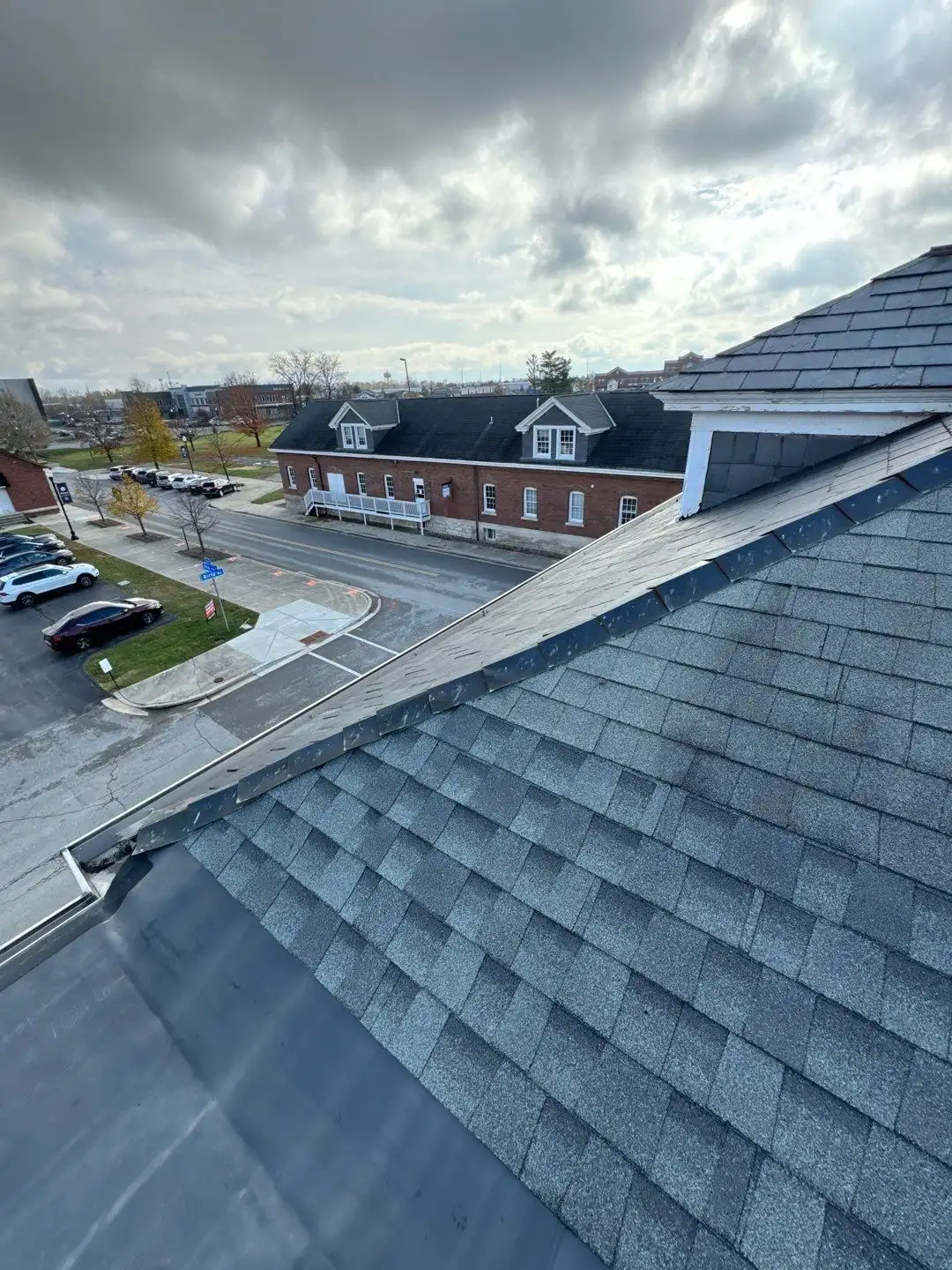
What is actually happening up there when your ceiling drips?
Think about your commercial roof as a system, not a surface. You have a membrane (TPO, EPDM, PVC, modified bitumen, or metal), insulation boards under that, a deck under that, and then your structure. When you see a drip inside, water has already made it through at least three of those layers. So the question is not just how do we stop the drip, but how much of that sandwich got wet?
Common leak sources we find in Carmel Arts District buildings? Failed pipe boots and HVAC curbs (probably 40% of calls), open seams on aging membrane, blown caps on screws and fasteners, blocked drains and scuppers that let water pond for days, and storm damage from wind lifted edges. If you have a flat or low slope roof, ponding is the silent killer. Two inches of standing water weighs about 10 pounds per square foot, and it finds every weak seam eventually.
Want to know what really catches people off guard? The leak you see inside is almost never directly below the actual breach. Water hits the deck, travels along a seam or a joist, and pops through the ceiling tile that happens to have the lowest point. We have tracked leaks 30 feet from where the customer was certain the problem was. That is why pulling a single ceiling tile and pointing at the spot above it rarely solves anything. You need somebody on the roof with a moisture meter and a real understanding of how that specific membrane system drains.
The first move when you spot a leak inside is not to climb up there. It is to protect what is below. Move inventory, tarp electronics, get buckets under the drip, and photograph everything before you touch it. Then call somebody who does commercial roof repair and can get eyes on the actual source. While you wait, an interior leak almost always means there is wet insulation and drywall that needs attention too. Our piece on attic water damage from roof leaks walks through what happens inside that ceiling cavity, and it applies to commercial buildings more than people think.
What does this realistically cost, and what drives the number?
You want a number. We get it. The honest answer is that commercial leak repair in Carmel Arts District ranges a lot depending on access, roof type, and how much wet material has to come out. Here is a rough breakdown of what we see, not a quote, just the lay of the land:
See that last bar? That is the one that ambushes building owners. You called for a roof repair and ended up with a water remediation project too. That is also why we tend to dispatch both crews when the situation calls for it. The roof side stops the source, and the interior side dries the building before mold sets in. If you want the deeper version of why drying speed matters so much, the breakdown on how fast mold grows after water damage is worth a read.
What about insurance? Good question, and the answer depends on the cause. Wear and tear from an aging roof is almost never covered. Storm damage, hail, wind lifted seams, and falling debris usually are. If you suspect storm involvement, document everything before any repair work starts. Take wide shots of the roof, close ups of the damage, photos of the interior staining, and save anything you have showing the storm date. We can usually pull weather reports for Carmel Arts District to back up the claim, and we work with adjusters all the time. Just do not let an adjuster talk you out of a legitimate claim because the damage looks small from the ground. Hail bruising on a membrane is sneaky and shortens roof life dramatically.
So when do you patch, and when do you stop pretending?
Honest question to ask yourself: how old is this roof, and how many times have you patched it already? A membrane in year 8 of a 20 year life span with one bad seam? Patch it. A membrane in year 19 with three leaks last winter and ponding near every drain? You are not repairing anymore, you are postponing. Repeated repairs on a tired roof get expensive fast, and every leak is also damaging the building under it.
The decision usually comes down to a few things. Is the leak isolated or are we seeing multiple soft spots when we walk it? Is the insulation under the membrane still dry, or does the moisture meter light up across a wide area? Are you planning to sell or refinance in the next couple years, because lenders ask about roof age. We will walk it with you, show you photos, and give you the straight version. Sometimes the answer is a $1,800 repair. Sometimes it is honestly time to talk replacement, and we will say so without pressure.
One more thing while we are being honest: if you call about a leak during a hard rain, the first move is almost always a dry in or temporary tarp to stop active intrusion, not a permanent repair. You cannot properly weld a seam to a wet membrane, and trying just creates a second failure point. We prioritize emergency dry ins for active leaks, then come back for the real fix once the roof is workable.
And after the repair? Do not just file the invoice and forget about it. Get on a basic maintenance rhythm. Twice a year, somebody walks the roof, clears the drains, checks the pitch pans and pipe boots, looks for blisters or splits, and documents it. That kind of routine catches the next problem at the $400 stage instead of the $6,000 stage. Carmel Arts District Commercial Roofing can set that up for you, or you can hand the checklist to your facilities crew. Either way, the buildings that do this just leak less. That is the whole secret.